Sunday, October 3, 2010

Sacrifice in Robin Hood


I was watching the movie Robin Hood when I came across a dialogue that is relevant to the kinds of sacrifice that we have discussed in class. During a latent battle in France, Robin Longbow(Robin Hood) is asked by King Richard, " Do you think God will be pleased with my sacrifice"? -This is in reference to his Crusade to take back the Holy Land. I take this to be asking whether or not God will be pleased with his "self-sacrifice" to do His will. Robin Hood had an interesting response to the question. First, he says explicitly that God will not be pleased and to drive the point home he recalls a moment when 2500 Muslims were rounded up to be slaughtered. A Muslim women looked up to him and he took that look to be one of pity, for the "God-less" things that were about to be done. This kind of sacrifice is horrifying because of the violence it provoked. In the case of the Crusades, thousands of people were killed by Crusaders who thought their God would be pleased with their sacrifice. This is a perfect example of Abraham's Curse. The curse being the willingness to kill or be killed for God. What makes this sacrifice justifiable, according to the Crusaders, is that sacrifice is looked at as a pious act, like in the case of Abraham. They would, most likely, not feel a sense of guilt for the blood that was being shed. The suffering of humans is not as important as their communion with God.

Saturday, October 2, 2010

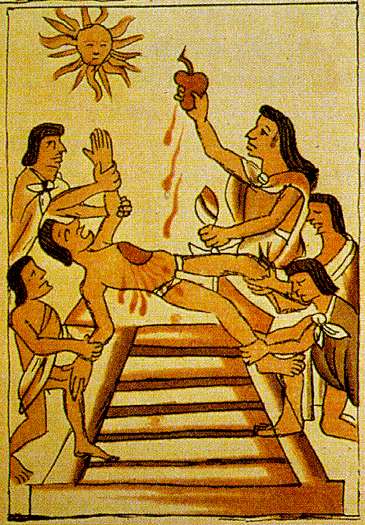
The Sacrifice of Women

http://www.latinamericanstudies.org/aztecs/aztecs40.gif

I recently checked out the book, City of Sacrifice, by David Carrasco. This is the book that contains the articles that we read in class about the sacrifices of the Aztecs. I read an interesting chapter about the sacrifice of women. The Aztecs ritually sacrificed women in one third of the yearly festivals. They believed women need to be sacrificed to bring about the rejuvenation of plants, children and war. David Carrasco sees these rituals of sacrifice as "cosmo-magical circles" or the "symbolic spaces where gods and humans actively exchanged their co-essences in order to participate in the rejuvenating forces of earth, animal, plant and sky."(pg. 190) In one festival, the Great Vigil, women go through a number of rituals and through this they become the "heart" of maze. They receive the invisible life force that gives plants the ability to regenerate. By their sacrifice, the earth would continue to run its course.
In my Religion 298 course we read the theories of James Frazer. He thought that there were three stages of progress that mankind had gone through: magic, religion and science. Magic was the earliest stage which was characterized by thinking certain rituals or practices, would control nature. Religion was subsequent to magic which held that by propitiating god(s), people would get what they needed. Science is in the last stage which states that nature isn't controlled by god(s) but is autonomous. When thinking about this theory, I am left wondering what stage the Aztecs would fall in. In the case of the Great Vigil, it seems they could be in both magic and religion. The women were transformed into gods and through their death, nature was rejuvenated. In this way, they were controlling nature but also cooperating with the god(s).