Monday, December 6, 2010
Concluding Thoughts
It is the end of the semester so I just wanted to share some concluding thoughts. The main thing that I learned this semester is that sacrifice does not just happen in religion. This semester we discussed sacrifice in warfare and in capital punishment, as well as in religion. In warfare the kinds of sacrifice are self-sacrifice and the killing of the enemy. The nation or ideology in warfare serves as a kind of god, who is being fought for and defended. The enemy serves as a kind of rival god, who is also battling for control and worship. Capital punishment is also responsible for sacrifice. The criminal serves as a sacrifice, who is given for the state, to keep the state in peace or collective harmony. In religion, we see sacrifice in the sacrifice of humans to the gods, as in the Aztec religion, and we also see sacrifice in the Crusades, where both sides were sacrificing themselves for god. In all these topics, violence is present. We learned in A Terrible Love of War, that violence has always been used and probably, always will. If this is the case, then sacrifice is here to stay.

Friday, December 3, 2010
Vengeance in A Time To Kill

I watched the movie, A Time to Kill, on TV the other night. The movie is about a man named Carl Lee Haily, played by Samuel L. Jackson, who guns down two white men that had raped his 10 year-old daughter. Jackson's character believed that they might be found not-guilty for the rape because of the deep seated racism in Mississippi, so he kills them. Subsequently, his defense attorney is able to sway the jury to find Haily not-guilty, even though he killed the two men in the courthouse with dozens of witnesses. It was interesting to me how the film made you side with Jackson's character and the whole time you wanted him to get away with murder. (The two rapists that he killed were also involved with the Klu Klux Klan, which didn't help their cause either.) This is an example of the vengeance that most of us want, when we see cases like this. The two men deserved to die and justice was done. I am against the killing of people for their crimes but sometimes I sway on this issue. What if Hailey didn't murder the two men and they were found not-guilty of rape and set free. Where's the justice there? I can't promise that I wouldn't do the same thing if that happened to my daughter. Films like these teach us that there is a sort ambivalence towards the death penalty and/or vengeance. Its seems illogical to be for it but because we are emotional beings, sometimes our logic is less important.
Tuesday, November 16, 2010
Life of the Defendant
One particular point I liked in the book When the State Kills, is in Chapter 4 when the author is discussing the capital case of William Brooks, who was found guilty of the rape and murder of Jeannine Galloway. The chapter narrates the trial but then comes to the penalty phase where the life of the defendant is discussed. Here we learn of the repeated abuse of the defendant by his father and stepfather that in turn created an angry man. The attorney for the defendant tries to put the crime in context by victimizing the defendant to try and sway the jury to discard the death penalty in sentencing. I actually thought the defense did well to bring up the childhood of the defendant because it is relevant to the case in that it makes him a victim and therefore might make the jury feel it unnecessary to add further pain. I think it is important to understand why someone might commit a crime because most violent criminals come from violent circumstances. Where is the Justice for them? I am not saying that their crimes are justified but at least we know where they are coming from. If they came from bad homes then they probably didn’t learn healthy ways to channel anger or other emotions. Is it really necessary to sentence them to death instead of a lifetime in prison? I think the defense attorney was right in saying, “He is responsible for what he did. That’s why we are here, why we are at this point. That’s been decided…Mitigating evidence is offered to help you understand what he did and why, not to excuse or justify it.”
Sunday, October 3, 2010
Sacrifice in Robin Hood

I was watching the movie Robin Hood when I came across a dialogue that is relevant to the kinds of sacrifice that we have discussed in class. During a latent battle in France, Robin Longbow(Robin Hood) is asked by King Richard, " Do you think God will be pleased with my sacrifice"? -This is in reference to his Crusade to take back the Holy Land. I take this to be asking whether or not God will be pleased with his "self-sacrifice" to do His will. Robin Hood had an interesting response to the question. First, he says explicitly that God will not be pleased and to drive the point home he recalls a moment when 2500 Muslims were rounded up to be slaughtered. A Muslim women looked up to him and he took that look to be one of pity, for the "God-less" things that were about to be done. This kind of sacrifice is horrifying because of the violence it provoked. In the case of the Crusades, thousands of people were killed by Crusaders who thought their God would be pleased with their sacrifice. This is a perfect example of Abraham's Curse. The curse being the willingness to kill or be killed for God. What makes this sacrifice justifiable, according to the Crusaders, is that sacrifice is looked at as a pious act, like in the case of Abraham. They would, most likely, not feel a sense of guilt for the blood that was being shed. The suffering of humans is not as important as their communion with God.
Saturday, October 2, 2010
The Sacrifice of Women
 http://www.latinamericanstudies.org/aztecs/aztecs40.gif
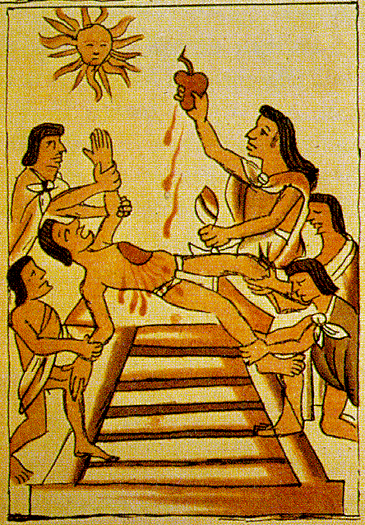
I recently checked out the book, City of Sacrifice, by David Carrasco. This is the book that contains the articles that we read in class about the sacrifices of the Aztecs. I read an interesting chapter about the sacrifice of women. The Aztecs ritually sacrificed women in one third of the yearly festivals. They believed women need to be sacrificed to bring about the rejuvenation of plants, children and war. David Carrasco sees these rituals of sacrifice as "cosmo-magical circles" or the "symbolic spaces where gods and humans actively exchanged their co-essences in order to participate in the rejuvenating forces of earth, animal, plant and sky."(pg. 190) In one festival, the Great Vigil, women go through a number of rituals and through this they become the "heart" of maze. They receive the invisible life force that gives plants the ability to regenerate. By their sacrifice, the earth would continue to run its course.
In my Religion 298 course we read the theories of James Frazer. He thought that there were three stages of progress that mankind had gone through: magic, religion and science. Magic was the earliest stage which was characterized by thinking certain rituals or practices, would control nature. Religion was subsequent to magic which held that by propitiating god(s), people would get what they needed. Science is in the last stage which states that nature isn't controlled by god(s) but is autonomous. When thinking about this theory, I am left wondering what stage the Aztecs would fall in. In the case of the Great Vigil, it seems they could be in both magic and religion. The women were transformed into gods and through their death, nature was rejuvenated. In this way, they were controlling nature but also cooperating with the god(s).
Monday, September 6, 2010
Japan's Death Chamber
I just read a short article on CNN.com that discusses the recent media's walk through the death chamber at the Toyko Detention facility. Apparently, this is the first time in Japan that the media was allowed to see where criminals are executed. I think this sort of experience would be good for most of us. If we were all able to see death chambers or even an actual death penalty being carried out, we would be in a better position to judge whether or not we are for or against it. It's too easy to hold certain opinions in theory but it's quite another thing to see where our opinions lead. Someone being killed by the State is a serious matter but most of us will never see it. Wouldn't this experience benefit us ?
This got me thinking about what the death penalty represents. Usually people that are sentenced to death row, at least in the US, have committed murder. This becomes a debt that is owed to the person that was killed, or the State. The State here acts as the god(s) that has been negatively affected or sinned against. The "sacrifice" of the criminal is like the sacrificial lamb in the Abrahamic religions. The State is now appeased with the sacrifice.
I was wondering, earlier in the semester, what the similarities were between the different forms of sacrifice that we would be studying. It makes so much sense now!
The link to the article is http://news.blogs.cnn.com/2010/08/27/japan-reveals-long-secretive-execution-process/?iref=allsearch
This got me thinking about what the death penalty represents. Usually people that are sentenced to death row, at least in the US, have committed murder. This becomes a debt that is owed to the person that was killed, or the State. The State here acts as the god(s) that has been negatively affected or sinned against. The "sacrifice" of the criminal is like the sacrificial lamb in the Abrahamic religions. The State is now appeased with the sacrifice.
I was wondering, earlier in the semester, what the similarities were between the different forms of sacrifice that we would be studying. It makes so much sense now!
The link to the article is http://news.blogs.cnn.com/2010/08/27/japan-reveals-long-secretive-execution-process/?iref=allsearch
Subscribe to:
Posts (Atom)